
Top 5 Revenue Streams in a Lithium-Ion Battery Recycling Plant
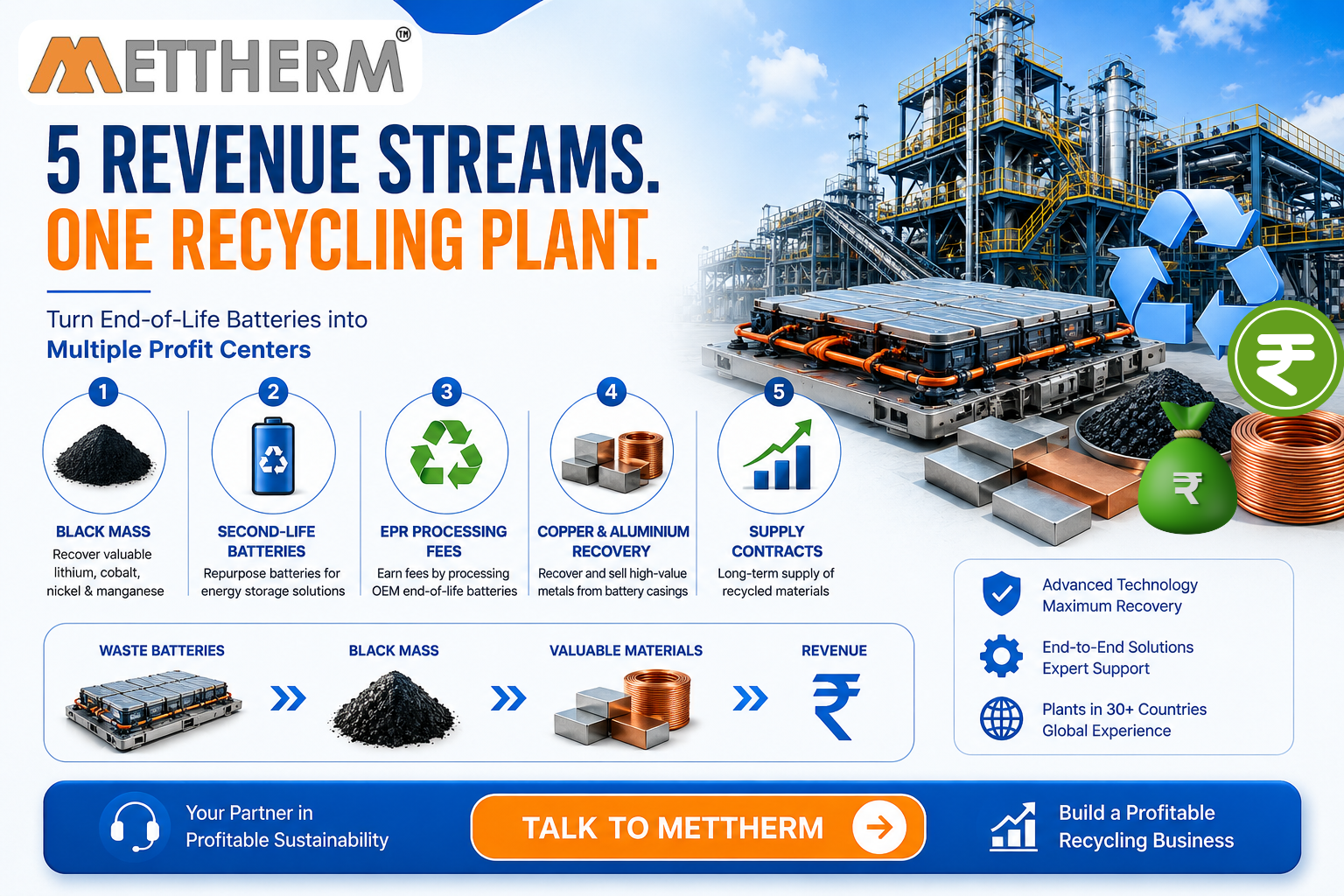
Most people who ask about setting up a lithium-ion battery recycling plant ask one question first — is it actually profitable? A well-designed lithium battery recycling plant does not rely on a single income source. It has multiple revenue streams that together make it one of the more resilient industrial businesses you can set up in India today.
- Black Mass Sales — lithium, cobalt, nickel, manganese recovery
- Metal Refining Byproducts — copper, aluminium from battery casings
- Second-Life Battery Refurbishment
- EPR Compliance Processing Fees
- Recycled Material Supply Contracts
Revenue Stream 1 — Black Mass Sales
Black mass is the dark powder produced when lithium battery cells are mechanically shredded in a controlled, inert environment. It contains lithium, cobalt, nickel, manganese, and carbon in concentrated form — exactly the materials that battery manufacturers need to make new cells.
| Material in Black Mass | Global Demand | Value Contribution |
|---|---|---|
| Cobalt | Very High — used in NMC cathodes | Highest per kg |
| Lithium | High — every battery needs lithium | Strong, growing |
| Nickel | High — NMC and NCA batteries | Significant |
| Manganese | Medium — NMC and LMO batteries | Moderate |
| Carbon | Lower — graphite anode material | Moderate |
Leading facilities achieve 90 to 95 percent recovery rates using hydrometallurgical processing. Domestically, buyers include battery cathode material producers. Internationally, South Korean, Japanese, and Chinese battery manufacturers are active buyers.
Revenue Stream 2 — Copper and Aluminium Recovery From Battery Casings
A lithium-ion battery contains copper current collectors, aluminium casings, steel enclosures, and various connectors. After cells are shredded for black mass, these structural components remain — and they have real scrap value.
- Copper foil and wiring — copper prices in India have been strong
- Aluminium casing and heat sinks — fully recyclable, consistent prices
- Steel enclosures and hardware — lower value but still recoverable
Unlike black mass prices which fluctuate with global commodity markets, domestic scrap metal prices tend to be more stable — providing a reliable secondary revenue layer.
Revenue Stream 3 — Second-Life Battery Refurbishment
When an EV battery is retired from a vehicle, it has typically lost 20 to 30 percent of its original capacity — but still holds 70 to 80 percent. For driving, that is not enough. For stationary energy storage, it is perfectly usable.
Where Do Second-Life Batteries Go?
- Solar energy storage — homes, commercial buildings, industrial facilities
- Telecom tower backup — a massive market in India
- UPS and data center backup — growing demand as data infrastructure expands
- Grid-scale energy storage — battery banks for load balancing
- EV charging station backup — buffer storage at fast-charging locations
Second-life batteries delay the need for full recycling by 5 to 7 years, extending the asset life and giving your facility a diversified revenue base.
Revenue Stream 4 — EPR Compliance Processing Fees
Under India’s Battery Waste Management Rules 2022, every company that manufactures or imports batteries must meet annual battery collection and recycling targets. Most large companies do not want to build and operate their own recycling plants. Instead, they partner with licensed recycling facilities — paying a processing fee per kilogram or tonne of batteries processed.
As a licensed lithium battery recycling plant operator, you become that partner. The OEM gets their compliance documentation. You get a processing fee — and the battery material itself, which feeds your black mass and metal recovery revenue streams.
- Not commodity-price dependent — it is a service fee, more stable
- Creates long-term partnerships with major companies
- As EPR targets increase annually, volumes flowing to your plant grow automatically
- Provides a guaranteed base load of raw material
Revenue Stream 5 — Long-Term Supply Contracts With Battery Manufacturers
India’s battery manufacturing sector is growing rapidly. The government’s PLI scheme has allocated ₹18,100 crore to develop 50 GWh of domestic battery manufacturing capacity. Companies building these facilities need a reliable, local supply of battery-grade materials — lithium, cobalt, nickel, and manganese.
Rather than selling recovered materials on the spot market, experienced recycling plant operators negotiate forward supply contracts with battery manufacturers. These contracts lock in a volume and price for recovered materials over 12 to 36 months — providing revenue predictability.
Putting It All Together
| Revenue Stream | Revenue Type | Stability | Scale Potential |
|---|---|---|---|
| Black Mass Sales | Commodity sales | Medium | Very High |
| Copper & Aluminium Recovery | Scrap metal sales | High | Medium |
| Second-Life Refurbishment | Product sales | High | High |
| EPR Processing Fees | Service fees | Very High | Very High |
| Supply Contracts | Long-term contracts | Very High | Very High |
The most resilient plants are those that actively develop all five streams. The processing fees and supply contracts provide stable base revenue. The black mass and metal recovery provide the upside when commodity prices are strong. Second-life refurbishment adds a differentiated product line with attractive margins.
How Mettherm Designs Plants That Capture All Five Revenue Streams
Mettherm has been building turnkey recycling solutions since 2000. With plants delivered across 30+ countries and over two decades of experience, our engineering team understands what a plant needs to be commercially viable — not just technically functional.
- Safe dismantling systems — handling lithium batteries without fire or explosion risk
- Black mass extraction line — shredding, classification, and drying for maximum yield
- Metal separation systems — copper, aluminium, and steel recovery
- Second-life testing and grading capability
- CPCB-compliant pollution control — fume extraction, wastewater treatment, zero discharge
- Full documentation systems — EPR compliance reporting and material traceability
- Custom capacity from 1 TPD to 50+ TPD
Contact: WhatsApp / Call: +91 98914 90089 | Email: info@mettherm.com
Frequently Asked Questions
Final Thoughts
A lithium-ion battery recycling plant is one of the few industrial businesses in India today where the fundamental demand drivers — regulatory requirements, growing EV fleet, critical mineral scarcity, government policy support — are all moving in the same direction at the same time.
The five revenue streams outlined here are the actual ways that operating lithium battery recycling businesses generate income today, in India and globally. If you are evaluating whether to enter this space, the revenue picture is genuinely attractive. If you have already decided, the next step is getting the plant design right — and that is where Mettherm can help.
Disclaimer: This article is for informational purposes only. All figures are indicative and based on publicly available industry data. Actual plant revenue depends on capacity, feedstock, commodity prices, and operational efficiency. Consult a qualified engineer and financial advisor before making investment decisions.