
Maruti, Hyundai & MG Electric Cars — What Happens to Their Batteries After Use?
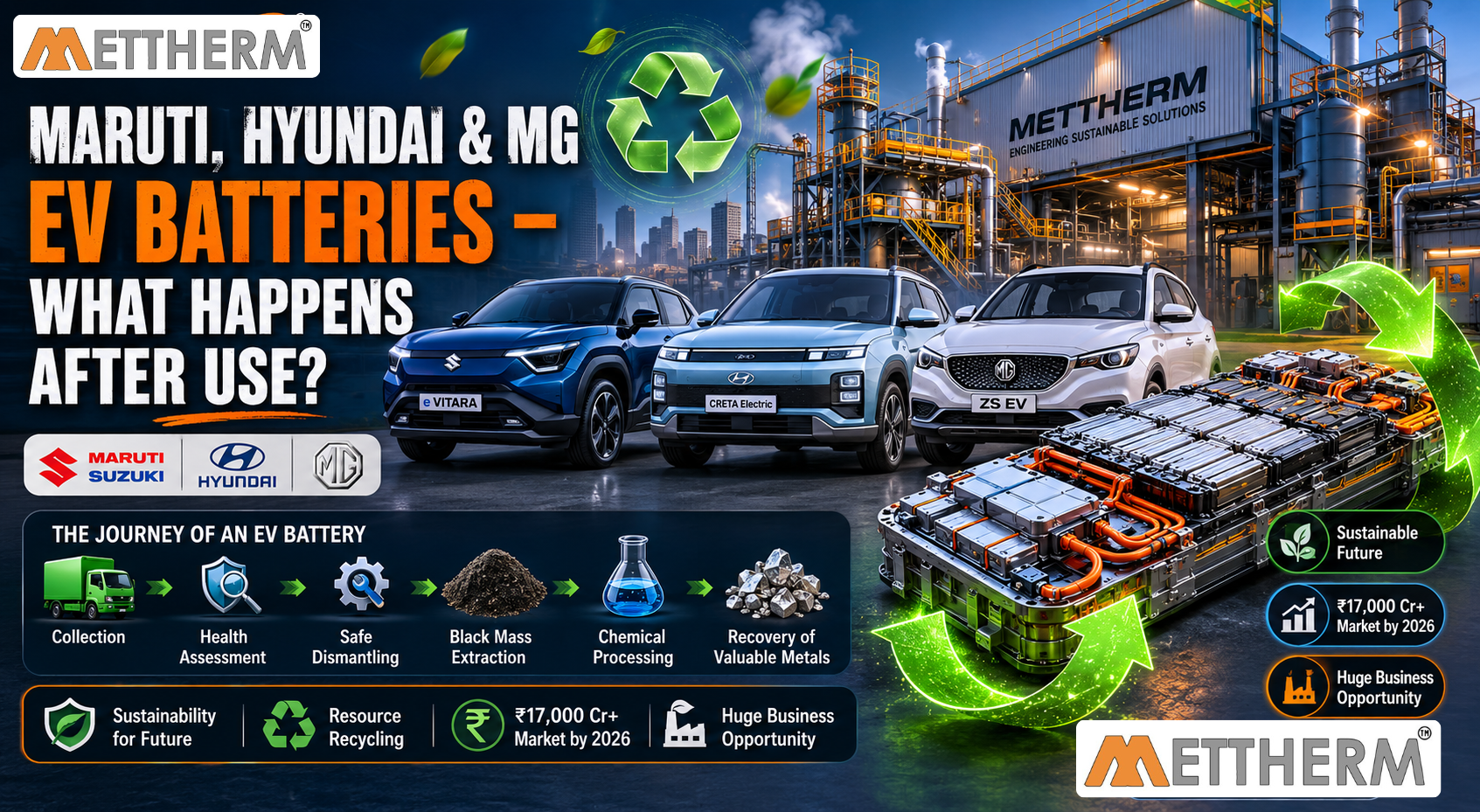
India’s electric vehicle market is growing faster than ever. Maruti Suzuki, Hyundai, and MG Motor are selling thousands of EVs every year. But one question nobody is asking loudly enough is — what happens to the batteries inside these cars once they stop working?
An EV battery lasts 8 to 10 years on average. After that, it must be either repurposed or recycled. With lakhs of EVs already running on Indian roads today, a massive wave of end-of-life batteries is coming between 2028 and 2035. This makes EV battery recycling one of the biggest business opportunities in India right now.
How Big Is India’s EV Battery Recycling Market?
- India battery recycling market valued at ₹17,000 crore by 2026
- NITI Aayog projects India will generate 128 GWh of recyclable batteries by 2030
- Electric two-wheeler sales in 2025 crossed 1.85 crore units
- EV battery capacity in India will reach 54 GWh by FY27 and 127 GWh by FY30
- Battery waste from EVs could exceed 1 crore tonnes between 2025 and 2040
- Current recycling infrastructure handles less than 10% of expected 2030 battery waste volumes
These numbers mean one thing — the demand for lithium-ion battery recycling plants in India is going to be enormous.
What Does Each Car Brand Do With Used EV Batteries?
🚗 Maruti Suzuki (e Vitara)
Maruti Suzuki is the latest entrant in India’s EV market with the e Vitara. Their authorized dealerships will act as collection points for end-of-life batteries. When millions of e Vitara batteries reach end-of-life in the coming decade, the volume going into India’s recycling ecosystem will be staggering — creating a massive raw material opportunity for licensed lithium-ion battery recycling plant operators.
🚙 Hyundai India (Creta Electric, Ioniq 5, Ioniq 6)
Hyundai India has partnered with Attero — India’s largest e-waste and battery recycler — to manage their end-of-life EV batteries. When a Hyundai EV battery reaches end-of-life, it is collected at authorized dealerships, transported to a licensed processing facility, safely dismantled, and the materials are recovered through advanced hydrometallurgical processing.
🚘 MG Motor India (ZS EV, Windsor EV, Comet EV)
MG Motor India, which holds approximately 13% of India’s passenger EV market, has also partnered with Attero for battery recycling. MG dealerships act as battery collection points, with materials then recovered at licensed facilities.
How Is an EV Battery Actually Recycled? (Step by Step)
Step 1 — Battery Collection and Transportation
When an EV owner reports reduced battery performance, the battery is collected at the authorized dealership. Under India’s EPR regulations, the automaker is legally responsible for this collection.
Step 2 — Battery Health Assessment (Second Life Evaluation)
Before recycling, every battery undergoes a health assessment. If the battery still holds 70–80% of its original capacity, it may be repurposed for second-life use — such as stationary energy storage for solar systems, telecom towers, or UPS backup. This can extend battery life by another 5–7 years.
Step 3 — Safe Dismantling at the Recycling Plant
At the lithium battery recycling plant, the battery pack is carefully dismantled into individual cells. This is a hazardous process — lithium-ion batteries can catch fire if not handled correctly. Specialized equipment and proper ventilation systems are mandatory.
Step 4 — Black Mass Extraction
The battery cells are shredded in a controlled environment to produce ‘black mass’ — a dark powder containing lithium, cobalt, nickel, manganese, and copper. Black mass is the most valuable output of lithium battery recycling.
Step 5 — Hydrometallurgical Processing
The black mass undergoes chemical processing to separate and recover each metal at high purity. This process recovers 90–95% of lithium, nickel, and cobalt — completing the circular economy loop.
India’s Law on EV Battery Recycling
India’s Battery Waste Management Rules 2022 make it mandatory for all EV manufacturers to take responsibility for the collection and recycling of their batteries.
- All automakers must register for EPR with CPCB
- Manufacturers must collect and recycle a minimum % of batteries sold — targets increase annually
- All recycling must be done at CPCB-authorized facilities only
- Budget 2025-26 removed customs duty on lithium-ion battery waste
- ₹410 crore allocated for National Critical Mineral Mission in FY 2025-26
What Is a Used EV Battery Worth?
| Battery Type | Cashback / Buyback Value | Recycling Cost per kg |
|---|---|---|
| Passenger Car EV Battery | ₹10,000 – ₹40,000 | ₹75 – ₹150 |
| Electric Scooter Battery | ₹2,000 – ₹8,000 | ₹75 – ₹100 |
| Electric Bus / Commercial | ₹50,000 – ₹2,00,000+ | Negotiated |
Business Opportunity — Why Set Up a Lithium Battery Recycling Plant Now?
India’s current recycling infrastructure handles less than 10% of expected 2030 battery waste volumes. This gap is the opportunity.
- First Mover Advantage — Early investors will have established operations before the massive wave of end-of-life batteries arrives between 2028 and 2035.
- Government Support — PLI scheme (₹18,100 crore for 50 GWh capacity), duty exemptions on battery waste, National Critical Mineral Mission.
- Guaranteed Raw Material Supply — As EV sales grow, the supply of used batteries becomes guaranteed through legally mandated EPR channels.
- Multiple Revenue Streams — Black mass sales, second-life refurbishment, processing fees from OEMs, copper and aluminium recovery.
Plant Investment Range
| Plant Scale | Investment Range |
|---|---|
| Small pilot plant (1–2 TPD) | ₹2 crore to ₹5 crore |
| Medium plant (5–10 TPD) | ₹10 crore to ₹25 crore |
| Large industrial (20+ TPD) | ₹50 crore and above |
How Mettherm Can Help You
Mettherm has been designing and manufacturing turnkey recycling plants since 2000. With 26+ years of experience and plants delivered to 30+ countries, Mettherm is India’s trusted partner for lithium-ion battery recycling plant setup.
- Complete turnkey lithium battery recycling plant design and supply
- Safe dismantling equipment and thermal management systems
- Black mass processing machinery
- CPCB-compliant pollution control and fume extraction systems
- Installation, commissioning, and staff training
- After-sales support and spare parts
- Custom capacity from 1 TPD to 50+ TPD
Contact: WhatsApp / Call: +91 98914 90089 | Email: info@mettherm.com
Frequently Asked Questions
Conclusion
The EV revolution is happening in India right now. Maruti, Hyundai, and MG are selling electric cars by the lakh. India needs thousands of licensed lithium-ion battery recycling plants to handle the wave of end-of-life batteries that is coming. The regulatory framework is in place, government support is in place, and raw material supply through EPR is guaranteed.
If you are planning to set up a lithium battery recycling plant in India, talk to Mettherm. With 26+ years of experience and plants delivered across 30+ countries, we will design the right plant for your business.
Disclaimer: This article is for informational purposes only. All figures are indicative and based on publicly available industry data. Consult a qualified engineer and financial advisor before making investment decisions.